
Core Java
This training program covers the essential concepts and practical aspects of Java, helping learners build logical thinking, write efficient programs, and gain the foundation required to develop real-world applications using Java.
Core Java
Core Java refers to the fundamental aspects of the Java programming language. It includes the basic concepts and features that form the foundation for all Java-based programming and development. Core Java is essential for understanding more advanced Java technologies and frameworks.
About Core Java
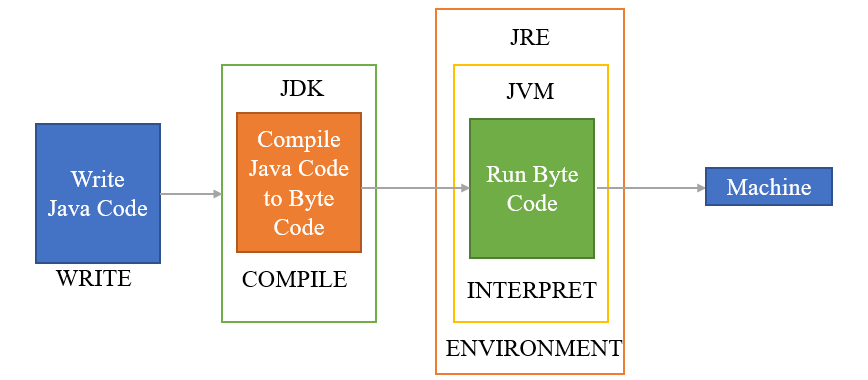
A strong understanding of Core Java is essential before progressing to advanced Java technologies, frameworks, and enterprise-level application development. Core Java focuses on the fundamental concepts and features of the Java programming language, including object-oriented programming, platform independence, memory management, multithreading, and exception handling. It also helps developers understand how Java works through the JDK, JRE, JVM, and bytecode.
Key Features of Core Java:
Object-Oriented Programming (OOP)
Core Java is inherently object-oriented, meaning it uses classes and objects to structure the code.
Platform Independence
Java code is compiled into bytecode, which can run on any machine equipped with the Java Virtual Machine (JVM), making it platform-independent.
Rich Standard Library
Java comes with a vast standard library that provides utilities for data structures, networking, database connectivity, GUI development, and much more.
Memory Management
Java has an automatic garbage collection mechanism that helps in efficient memory management.
Multithreading
Java supports multithreading, allowing concurrent execution of two or more threads to maximize CPU utilization.
Contribution and Industrial Dependency of Java
Java is a widely used programming language known for its versatility, reliability, and scalability. Many key applications and platforms across various domains are developed in Java. Here are some notable examples:
Enterprise and Business Applications
- Apache Hadoop: A framework that allows for the distributed processing of large data sets across clusters of computers.
- Spring Framework: A comprehensive programming and configuration model for modern Java-based enterprise applications.
- Apache Tomcat: An open-source implementation of the Java Servlet, JavaServer Pages, and Java Expression Language technologies.
- IBM WebSphere: A set of Java-based tools from IBM that allows users to create and manage sophisticated business websites.
Financial Services
- Murex: A trading, risk management, and processing platform.
- Goldman Sachs' SecDB: A risk management and trading system.
Big Data Technologies
- Apache Kafka: A distributed event streaming platform.
- Apache Spark: An open-source unified analytics engine for large-scale data processing.
Web Applications
- LinkedIn: The backend of LinkedIn is heavily based on Java.
- eBay: Uses Java for various backend services.
Content Management Systems (CMS)
- Alfresco: An enterprise content management system.
- Liferay: A portal and collaboration platform.
Android Development
- Android Apps: Many Android applications are developed using Java, as Android’s primary development language was originally Java.
Scientific Applications
- MATLAB: Although primarily written in C, Java is used in certain parts of the application.
- HDF5: Hierarchical Data Format, a set of file formats designed to store and organize large amounts of data.
Government and Public Sector
- NASA WorldWind: A software development kit (SDK) that allows developers to create interactive visualizations of 3D globe and map data.
E-commerce
- Amazon: Uses Java for various backend systems.
- Walmart: Java is used in its global online retail operations.
Middleware Products
- JBoss: An open-source Java-based application server.
Integrated Development Environments (IDEs)
- Eclipse: A popular Java-based IDE.
- IntelliJ IDEA: Another widely used Java IDE.
Gaming
- Minecraft: Originally developed in Java, it's one of the most popular games globally.
Java’s platform independence, object-oriented nature, and robust libraries make it a popular choice for these diverse applications and platforms.
Complete Core Java Syllabus
11 Modules · 6 Weeks

The syllabus for Core Java can be broken down into several key topics, each focusing on different aspects of the language and its fundamental concepts. Here’s a detailed breakdown of a typical Core Java syllabus.
-
- History of Java
- Features of Java
- Java Development Kit (JDK) and Java Runtime Environment (JRE)
- Installing and setting up Java environment
- Writing, compiling, and running a simple Java program
-
- Contol Statement
- Primitive Data Types
- Arrays
- String
-
- Reference Data Types
- Operator Identifiers
-
- Encapsulation
- Inheritance and Method Overriding
- Polymorphism
- Data Abstraction/hiding
-
- Errors
- Exception Handling
- Propagation
-
- Introduction to Collections Framework
- List, Set, and Map interfaces
- Enumeration
- Generics
- Comparable/ Comparator
-
- Race Condition
- Monitor
- Synchronization
-
- Read/Write File
- Decorator Classes
- Serialization and Deserialization
-
- Introduction to lambda expressions
- Functional interfaces
- Using lambda expressions with collections
- Stream API for data processing
-
- Integrated Development Environments (IDEs) like Eclipse, IntelliJ IDEA
- Debugging Java applications
- Writing unit tests with JUnit
- Best coding practices in Java
-
- Summary of key concepts
- Best practices for writing efficient and maintainable Java code
- Resources for further learning and practice
This syllabus provides a comprehensive overview of Core Java, covering the essential topics required to build a strong foundation in Java programming.
Why Should a Student or Professional Learn Java?
- Widely Used: Java is one of the most popular programming languages in the world, with a vast community of developers and extensive resources available for learning.
- Versatility: Java is used in a variety of domains including web development, mobile development, desktop applications, and enterprise systems.
- Job Opportunities: Proficiency in Java opens up numerous job opportunities in various sectors such as finance, healthcare, e-commerce, and more.
- Strong Foundation: Learning Java provides a strong foundation in object-oriented programming, which is beneficial for learning other programming languages and technologies.
- Rich Ecosystem: Java's ecosystem includes a plethora of libraries, frameworks, and tools that enhance productivity and efficiency.
- Community Support: With a large and active community, students can easily find help and resources for problem-solving and learning.
- Future-Proof: Java continuously evolves, with regular updates and a focus on backward compatibility, ensuring its relevance in the future.
By learning Core Java, students not only gain a deep understanding of fundamental programming concepts but also position themselves well for advanced learning and career opportunities in software development.
Interesting Facts
Java is a widely used, versatile programming language with a rich history and many unique features. Here are some interesting facts about Java:
1. History and Development
Origin
Java was created by James Gosling and his team at Sun Microsystems in the early 1990s. The language was initially called "Oak," named after an oak tree outside Gosling's office.
Release
The first public implementation was released in 1995 as Java 1.0. It quickly gained popularity for its "write once, run anywhere" capability.
Ownership
In 2009, Oracle Corporation acquired Sun Microsystems, and with it, Java. Oracle has since been responsible for its development and maintenance.
2. Language Features
Platform Independence
Java's motto is "write once, run anywhere" (WORA). Java programs are compiled into bytecode, which can run on any device equipped with a Java Virtual Machine (JVM).
Object-Oriented
Java is a purely object-oriented programming language, which means everything is an object, except for primitive types.
Automatic Memory Management
Java has an automatic garbage collection system that helps manage memory by reclaiming unused objects.
Rich Standard Library
Java comes with an extensive standard library that provides many useful classes and interfaces for data structures, networking, input/output, GUI development, and more.
3. Performance and Usage
Performance
While traditionally slower than languages like C++, modern JVM implementations have significantly improved Java's performance through techniques like Just-In-Time (JIT) compilation.
Scalability
Java is known for its scalability, making it a popular choice for large-scale enterprise applications.
Security
Java has built-in security features, including the sandboxing of applets and runtime constraints that help prevent unauthorized access to system resources.
4. Applications and Industry Impact
Wide Adoption
Java is used in a variety of domains, including web applications, mobile applications (especially Android apps), enterprise software, scientific computing, and financial services.
Android Development
Java is the primary language for developing Android applications, although Kotlin has gained popularity in recent years.
Enterprise Solutions
Java is a cornerstone of enterprise environments, with frameworks like Spring and Hibernate making it a preferred choice for large-scale business applications.
5. Unique Aspects
JVM Languages
Java's ecosystem supports many other languages that run on the JVM, including Kotlin, Scala, Groovy, and Clojure, offering developers a wide range of options.
Portability
Java bytecode can run on any platform with a compatible JVM, ensuring that Java applications are highly portable.
Strong Typing
Java is a statically typed language, meaning that type checking is performed at compile time, which helps catch errors early in the development process.
6. Fun Facts
Popular TIOBE Index
Java has consistently ranked high on the TIOBE Index, which measures the popularity of programming languages. It often competes with languages like C and Python for the top spot.
Java in Space
Java is used in various space exploration projects, including the Mars Rover and the Hubble Space Telescope, thanks to its reliability and robustness.
Java Community Process (JCP)
Java's evolution is guided by the Java Community Process, a collaborative effort involving developers and organizations to develop and revise Java technologies.
7. Miscellaneous
Java Mascot
The Java mascot is Duke, a friendly-looking, triangular character often seen in Java promotional materials.
Origin of the Name
The name "Java" was inspired by Java coffee, reflecting the language's goal to be lively and energizing.