
Java Fullstack
Explore the world of Java full stack development. Learn about Java full stack, full stack web development, developer salaries in India, serialization in Java, OOP concepts, Django, and Spring Boot annotations.
Java Fullstack
Full-Stack Java Development combines frontend and backend development using Java-based technologies to create dynamic and responsive web applications. This comprehensive course covers both client-side and server-side programming, enabling individuals to build end-to-end solutions.
| Duration | 4 Months | Class Hours | 1 hour/day |
| Lab Hours | 3 hours/day | Prerequisite | Core Java, advance Java, JDBC, JSP/Servlet |
| Certificate | After successful completion of training | Trainer | Industry Experienced Mentor |
| Study Material | Books, Notes and Online Tests | Online Test | Unlimited |
| Project | Yes | Lectures In | English / Hinglish / Hindi |
| Fees | ₹ 30,000/- + 18% GST | Placement Support | Access our job portal, regularly updated with the latest openings from leading companies in the software industry. |
| Complimentary | Laptop Bag and T-Shirt | ||
About Java Fullstack
Proficiency in Full-Stack Java Development empowers individuals to design, develop, and deploy scalable web applications that meet business requirements. Understanding frontend frameworks, backend frameworks, and databases is essential for building modern web applications that deliver a seamless user experience.
Moreover, Full-Stack Java Developers are in high demand in the software industry, as they possess a diverse skill set that allows them to work on various components of web applications. Learning Full-Stack Java Development not only enhances career prospects but also provides opportunities to work on exciting projects and contribute to innovative solutions.
Complete Java Fullstack Syllabus
6 Modules · 4 Months
-
Week 1: Introduction to ReactJS
- Overview of ReactJS and its features
- Setting up the React development environment
- Creating and running a simple React application
- JSX syntax
- Components, Props, and State
-
Week 2: Advanced ReactJS
- Lifecycle methods
- Handling events
- Conditional rendering
- Lists and keys
- Forms and controlled components
-
Week 3: State Management with Redux
- Introduction to Redux
- Setting up Redux in a React application
- Actions, Reducers, and Store
- Connecting React components to Redux
- Middleware and asynchronous actions with Redux Thunk
-
Week 4: React Router and Advanced
Topics
- React Router for navigation
- Route parameters and nested routes
- Code splitting and lazy loading
- Testing React components
- Optimizing React applications
-
Week 5: Introduction to Spring Boot
- Overview of Spring Boot and its advantages
- Setting up the Spring Boot development environment
- Creating a simple Spring Boot application
- Understanding application.properties and YAML configuration
- Spring Boot DevTools for development
-
Week 6: RESTful Web Services with Spring
Boot
- Creating RESTful APIs with Spring Boot
- HTTP methods and status codes
- Request mapping and handling
- Path variables and request parameters
- ResponseEntity and exception handling
-
Week 7: Data Access with Spring Data
JPA
- Introduction to Spring Data JPA
- Setting up JPA with Spring Boot
- Creating and managing entities
- Repository pattern
- Query methods and custom queries
-
Week 8: Spring Security
- Introduction to Spring Security
- Setting up Spring Security in a Spring Boot application
- Authentication and authorization
- Securing RESTful APIs
- Role-based access control
- JWT (JSON Web Token) for authentication
-
Week 9: Spring Boot with MySQL
- Setting up a MySQL database
- Configuring Spring Boot to connect to MySQL
- CRUD operations with Spring Data JPA
- Handling database migrations with Flyway or Liquibase
-
Week 10: Spring Batch
- Introduction to Spring Batch
- Setting up Spring Batch in a Spring Boot application
- Creating batch jobs
- Chunk-oriented processing
- Managing job parameters and job execution
-
Week 11: Spring Boot Testing
- Unit testing with JUnit and Mockito
- Integration testing with Spring Boot
- Testing RESTful APIs with MockMvc
- Test containers for database testing
-
Week 12: Microservices with Spring
Boot
- Introduction to microservices architecture
- Creating microservices with Spring Boot
- Inter-service communication with REST and messaging
- Service discovery with Eureka
- API Gateway with Spring Cloud Gateway
-
Week 13-14: Project Planning and
Design
- Requirement analysis and project planning
- Designing the application architecture
- Creating wireframes and UI/UX design
- Setting up the project repository and initial setup
-
Week 15: Capstone Project Development
- Requirement analysis and project planning
- Designing the application architecture
- Implementing core functionalities
- Integrating frontend (ReactJS) and backend (Spring Boot)
- Implementing user authentication and authorization
- Handling form submissions and validations
- Testing and debugging
-
Week 16: Deployment and Cloud Hosting
- Introduction to cloud computing and AWS
- Setting up an AWS account
- Configuring NGINX for deployment
- Deploying the web application on AWS EC2
- Managing application logs and monitoring
-
Week 17: Review and Assessments
- Code reviews and feedback sessions
- Final assessments and quizzes
- Project showcase
- Internship completion certificate distribution
-
- Weekly code reviews and feedback sessions
- Pair programming and group discussions
- Regular quizzes and assessments
- Guest lectures and workshops on industry best practices
By the end of this program, participants will have a thorough understanding of ReactJS, JPA, Spring Boot, Spring Security, Spring Batch, MySQL, and the ability to develop and deploy an enterprise-level web project on AWS Cloud using NGINX. They will gain hands-on experience through real-world projects, preparing them for a successful career as a Java Full Stack Developer.
Why Should a Student or Professional Learn Java Full-Stack Development ?
- Comprehensive Skill Set: Full-Stack Java Development equips individuals with frontend and backend programming skills, database management knowledge, and DevOps practices.
- High Demand: Full-Stack Java Developers are in high demand in the software industry, as they possess the ability to work on various components of web applications.
- Career Opportunities: Learning Full-Stack Java Development opens up diverse career opportunities in software development, web application development, and IT consulting.
- Flexibility and Innovation: Full-Stack Java Developers have the flexibility to work on different parts of web applications and contribute to innovative solutions that meet business requirements.
Whether you're a student exploring career options or a professional seeking to enhance your skills, learning Full-Stack Java Development is a strategic investment that can lead to exciting career opportunities and professional growth in the dynamic field of software development.
Interesting Facts
Java Full Stack development covers both front-end and back-end technologies, offering a complete solution for building web applications. Here are some key facts:
1. Comprehensive Skill Set
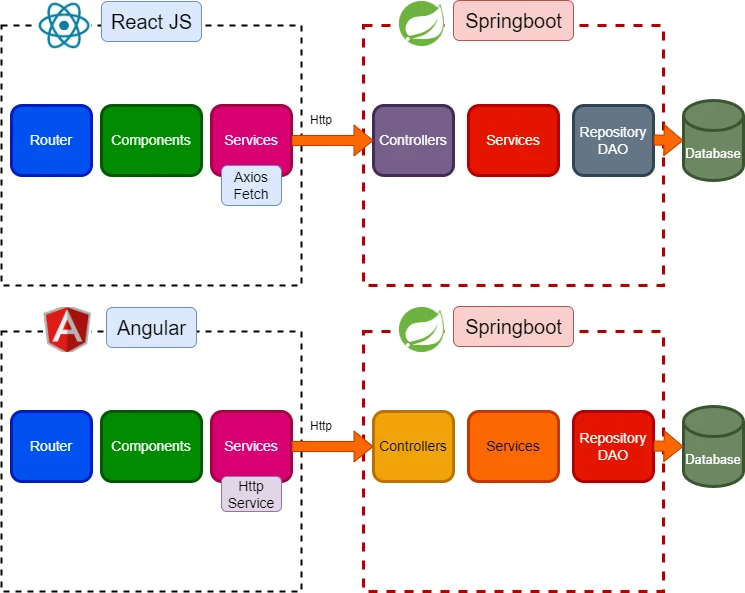
Java Full Stack developers work with front-end technologies like HTML, CSS, JavaScript, and frameworks like Angular or React.
They use Java frameworks like Spring Boot and Hibernate for back-end development, handling server-side logic and database interactions.
2. Popular Frameworks
Spring Boot simplifies the development of microservices and web applications, while Thymeleaf integrates well with Java for server-side HTML rendering.
Angular and React are commonly used to create dynamic user interfaces that work seamlessly with Java back-ends.
3. Industry Demand
Java Full Stack developers are in high demand for their versatility in handling both client-side and server-side development.
They are crucial for building scalable enterprise applications, making them valuable in large organizations.
4. Unique Aspects
Java Full Stack developers often work with microservices architecture, ensuring flexibility and scalability in application development.
They integrate DevOps practices like CI/CD and containerization, streamlining the development and deployment processes.
5. Fun Facts
Java Full Stack developers create hybrid applications that work across multiple platforms and devices.
The Java Full Stack community is active, offering numerous resources for learning and staying updated with industry trends.
Training Program Fee
Get Personalized Career Guidance
Our admissions team specializes in helping students choose the right career path for their goals.