
C language
C language
C language, developed in 1972 by Dennis Ritchie at Bell Labs, is a versatile and widely used programming language known for its efficiency and direct access to system-level resources. It serves as a foundational language in computer science and software development, valued for its portability and performance.
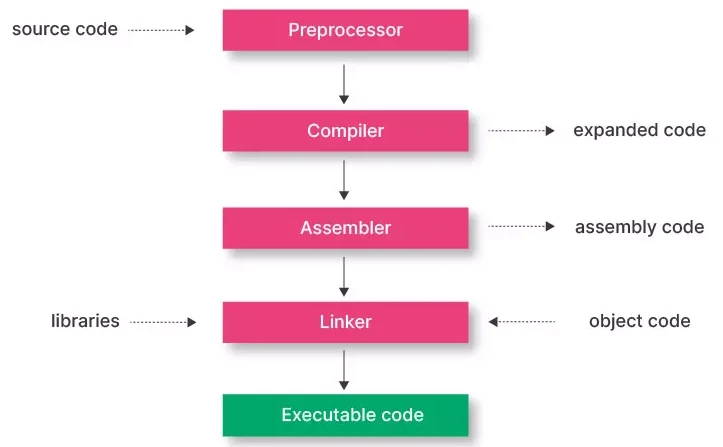
About C language
Known for its structured approach and powerful capabilities, C is used extensively in developing operating systems, compilers, embedded systems, and applications where performance and control over hardware are critical. Its syntax and semantics influenced many modern programming languages, making it essential knowledge for programmers across various domains.
Mastering C language involves understanding concepts such as variables, data types, control structures (like loops and conditionals), functions, and pointers. These fundamentals enable developers to write efficient, low-level code and build robust software solutions.
Complete C language Syllabus
8 Modules · 4 Weeks

-
Introduction to Programming
- Basics of Programming
- Programming Paradigms
-
History and Features of C
- Origin of C
- Features and Benefits
-
Structure of a C Program
- Writing the First Program
- Compiling and Executing a Program
-
Data Types and Variables
- Basic Data Types
- Variable Declaration and Initialization
- Constants and Literals
-
Operators in C
- Arithmetic Operators
- Relational Operators
- Logical Operators
- Bitwise Operators
- Assignment Operators
- Miscellaneous Operators
-
Expressions
- Evaluation of Expressions
- Precedence and Associativity
- Type Conversions
-
Basic I/O Functions
- Using printf() and scanf()
- Formatted I/O
-
File I/O
- Reading from and Writing to Files
- File Operations and Modes
-
Decision Making
- if, if-else, Nested if-else
- switch-case
-
Looping Constructs
- for Loop
- while Loop
- do-while Loop
-
Jump Statements
- break, continue
- goto
-
Introduction to Functions
- Function Declaration and Definition
- Calling Functions
- Function Prototypes
-
Parameter Passing
- Call by Value
- Call by Reference
-
Scope and Lifetime of Variables
- Local and Global Variables
- Static and Dynamic Scope
-
Recursion
- Basics of Recursion
- Recursive Functions
-
Arrays
- One-Dimensional Arrays
- Multi-Dimensional Arrays
- Array Manipulation
-
Strings
- String Handling Functions
- Array of Strings
-
Basics of Pointers
- Pointer Declaration and Initialization
- Pointer Arithmetic
- Pointers and Arrays
- Array of Pointers
- Pointer to Array
-
Pointers and Functions
- Passing Pointers to Functions
- Function Returning Pointers
-
Dynamic Memory Allocation
- malloc(), calloc(), realloc(), and free()
-
Structures
- Defining and Using Structures
- Array of Structures
- Nested Structures
-
Unions
- Defining and Using Unions
- Difference between Structures and Unions
-
Enums and Typedef
- Enumerated Data Types
- Type Definition
This curriculum covers comprehensive topics essential for learning C programming, from basic concepts to advanced topics like pointers, dynamic memory allocation, and file handling. Mastering these modules will provide a solid foundation for developing efficient and scalable software in C.
Why Should a Student or Professional Learn C Language?
- Foundation of Programming: C is considered a fundamental language that forms the basis of many other languages. Learning C provides a strong foundation in programming principles and logic.
- Efficiency and Speed: C is known for its efficiency and speed in execution. It allows programmers to write highly optimized code, making it suitable for systems programming and embedded systems.
- Portable and Widely Used: C code can run on various platforms with minimal changes, making it highly portable. It is widely used in operating systems, compilers, and application software development.
- Low-level Manipulation: C offers direct access to system-level resources and hardware, allowing programmers to perform low-level memory manipulation and achieve fine-grained control over system resources.
- Career Opportunities: Proficiency in C opens doors to a wide range of career opportunities in software development, system programming, game development, and embedded systems design.
Whether you're starting your journey in programming or looking to advance your career, learning C language equips you with essential skills and knowledge that are valuable across various domains of computer science and software engineering.
Interesting Facts
C is a foundational programming language. It influenced many languages and is used in operating systems, embedded systems, and compilers. Here are some interesting facts about C language:
Birth of C
C was developed in 1972 by Dennis Ritchie at Bell Labs. It was created as a system programming language to write the UNIX operating system, which remains widely used today.
Influential Language
C has significantly influenced many other popular programming languages, including C++, Java, C#, Objective-C, and even Python. These languages borrow many concepts and syntax from C.
Portability
One of the main reasons for C’s success is its portability. Programs written in C can be run on different types of computers with minimal modification, making it ideal for system software and embedded systems.
Speed and Efficiency
C is known for its performance. Programs written in C are often faster and more efficient than those written in other higher-level languages due to its low-level access to memory and system resources.
Standardization
The American National Standards Institute (ANSI) standardized C in 1989, creating the ANSI C standard. This was later followed by the International Organization for Standardization (ISO) in 1990, ensuring consistency in C implementations.
Legacy and Modern Use
Despite being over 50 years old, C is still widely used in modern software development, particularly in systems programming, embedded systems, and high-performance computing. Many operating systems, compilers, and other critical software are written in C.
Minimalism
C is known for its minimalistic design, providing only the essential features needed for system programming. This minimalism contributes to its efficiency and power but also means it lacks some features found in more modern languages.
C and Unix
C was specifically designed to implement the Unix operating system. Unix itself is written in C, making C one of the foundational languages in the history of modern computing.
Memory Management
C gives programmers direct control over memory management through pointers, which can lead to very efficient programs but also requires careful handling to avoid memory leaks and other issues.
Cross-Platform Compatibility
Due to its widespread adoption and standardization, C code can be compiled and run on a variety of platforms, from microcontrollers to supercomputers.