
Core Python
Learn the basics of Python programming with our comprehensive Core Python training. Perfect for beginners, this course covers Python basics, projects, and essential programming concepts.
Core Python
The Core Python language forms the foundation for all Python programming, encompassing essential syntax, data structures, and basic operations. It includes built-in types such as lists, dictionaries, and sets, as well as fundamental constructs like loops, conditionals, and functions. Core Python is known for its readability and simplicity, enabling rapid development and easy debugging. Its extensive standard library supports a wide range of tasks, from file I/O to regular expressions, making it versatile for various applications.
| Duration | 6 Weeks | Class Hours | 1 hour/day |
| Lab Hours | 1 hour/day | Prerequisite | Basic Programming Knowledge |
| Certificate | After successful completion of training | Trainer | Industry Experienced Mentor |
| Study Material | Books, Notes and Online Tests | Online Test | Unlimited |
| Project | Yes | Lectures In | English / Hinglish / Hindi |
| Fees | ₹ 5,000/- + 18% GST | Placement Support | No |
| Complimentary | T-Shirt | ||
About Core Python
Beyond the basics, Core Python promotes best practices such as modular programming and code reuse through modules and packages. It supports object-oriented programming, allowing the creation of reusable and organized code. Core Python is platform-independent, which means programs can run on various operating systems without modification. This foundational knowledge is essential for progressing to more advanced Python frameworks and libraries, making Core Python a critical skill for any developer.
Key Features of Core Python:
Simple and Easy to Learn
Python has a straightforward syntax and is easy for beginners to grasp.
Interpreted Language
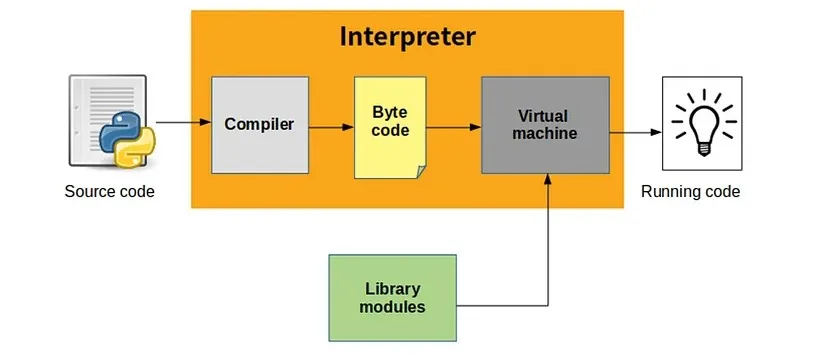
Python is an interpreted language, allowing for quick development and testing of code.
Dynamic Typing
Python uses dynamic typing, allowing variables to be assigned without specifying their type explicitly.
Rich Standard Library
Python comes with a comprehensive standard library that provides support for various tasks such as file handling, networking, and database operations.
High-level Language
Python is a high-level language, meaning it abstracts complex details from the programmer and allows for faster development.
Contribution and Industrial Dependency of Python
Contribution to Software Development:
Web Development
Python is widely used in web development frameworks like Django and Flask.
Data Science and Machine Learning
Python is the language of choice for data science and machine learning projects due to its extensive libraries like NumPy, Pandas, and TensorFlow.
Automation and Scripting
Python is commonly used for automation tasks, scripting, and system administration.
Scientific Computing
Python is used in scientific computing for numerical simulations, data analysis, and visualization.
Desktop GUI Applications
Python can be used to develop desktop GUI applications using libraries like Tkinter and PyQt.
Industrial Dependency:
Technology Companies
Leading technology companies like Google, Facebook, and Amazon use Python extensively for various purposes.
Finance and Trading
Python is used in finance and trading for quantitative analysis, algorithmic trading, and risk management.
Startups
Many startups choose Python for its simplicity and flexibility in building minimum viable products (MVPs) and prototypes.
Education and Research
Python is widely used in educational institutions and research organizations for teaching and conducting experiments.
Healthcare and Bioinformatics
Python is used in healthcare for medical imaging, patient data analysis, and bioinformatics research.
Complete Core Python Syllabus
13 Modules · 6 Weeks
The syllabus for Core Python can be broken down into several key topics, each focusing on different aspects of the language and its fundamental concepts. Here’s a detailed breakdown of a typical Core Python syllabus.
-
- History of Python
- Features of Python
- Installing Python
- Writing and running Python programs
- Basic syntax and data types
-
- Install Python
- Install Python Editor
-
- Variable assignment and naming conventions
- Numeric, string, and boolean operators
- Arithmetic, comparison, and logical operators
-
- If-else statements
- Loops (for, while)
- Break and continue statements
- Pass statement
-
- Access the Elements of an Array
- The Length of an Array
- Operations in Array
-
- Classes and objects
- Attributes and methods
- Inheritance and polymorphism
- Encapsulation and abstraction
-
- Types of exceptions
- Try-except blocks
- Handling specific exceptions
- Raising exceptions
-
- Creating and importing modules
- Exploring the Python Standard Library
- Installing and using third-party packages
-
- Defining and calling functions
- Parameters and arguments
- Return values
- Lambda functions
-
- Opening and closing files
- Reading from and writing to files
- Working with different file formats (CSV, JSON, XML)
-
- Introduction
- Creating and starting thread
- Thread Names
- Thread Life Cycle
- Key Methods
- Daemon Thread
- Create Daemon Thread
- Synchronisation
- Create Multiple Threads to check Concurrency
- Working with join() Method in Threads
- Create Thread with join()
- The Threading Module
- Thread Priority
-
- Overview of GUI frameworks (Tkinter, PyQt, Kivy)
- Creating simple GUI applications
- Event-driven programming
-
- Summary of key concepts
- Resources for further learning and practice
This syllabus provides a comprehensive overview of Core Python, covering essential topics required to build a strong foundation in Python programming.
Why Should a Student or Professional Learn Python?
- Easy to Learn: Python has a simple and readable syntax, making it easy for beginners to pick up.
- Versatility: Python is used in various domains such as web development, data science, machine learning, and automation.
- High Demand: Python developers are in high demand across industries, leading to lucrative job opportunities.
- Community Support: Python has a large and active community that provides extensive support and resources for learning.
- Rich Ecosystem: Python has a vast ecosystem of libraries and frameworks that enhance productivity and efficiency.
- Future-Proof: Python is continuously evolving, with regular updates and improvements, ensuring its relevance in the future.
By learning Python, students and professionals can acquire essential programming skills and open doors to a wide range of career opportunities.
Interesting Facts
Python is a highly popular and versatile programming language with a rich history and many unique characteristics. Here are some interesting facts about Python:
1. History and Development
Origin
Python was created by Guido van Rossum and first released in 1991. Van Rossum started working on Python as a holiday project to keep himself busy during Christmas.
Name
The name "Python" was inspired by the British comedy group Monty Python, reflecting Van Rossum's desire to make the language fun to use.
Open Source
Python has always been open source, with a large and active community contributing to its development and improvement.
2. Language Features
Readability
Python emphasizes readability and simplicity, using indentation to define code blocks instead of curly braces or keywords.
Interpreted Language
Python is an interpreted language, meaning it is executed line by line, which makes debugging and testing easier.
Dynamically Typed
Python is dynamically typed, so variables do not need explicit declarations, and types are determined at runtime.
Extensive Standard Library
Python's standard library is vast and includes modules for everything from file I/O and system calls to web development and data manipulation.
3. Performance and Usage
Versatility
Python is used in a wide range of applications, including web development, data science, artificial intelligence, scientific computing, and automation.
Cross-Platform
Python is cross-platform and runs on various operating systems, including Windows, macOS, Linux, and even on some mobile devices.
Popularity
Python consistently ranks among the most popular programming languages, often competing with JavaScript and Java for the top spots.
4. Applications and Industry Impact
Web Development
Python is widely used in web development, with popular frameworks like Django, Flask, and Pyramid.
Data Science and Machine Learning
Python is a dominant language in data science and machine learning, thanks to libraries like NumPy, pandas, scikit-learn, TensorFlow, and PyTorch.
Education
Python is often chosen as the first programming language for beginners due to its simplicity and readability.
Scripting and Automation
Python is frequently used for scripting and automating repetitive tasks, making it a favorite among system administrators and DevOps engineers.
5. Unique Aspects
Indentation-Based Syntax
Python uses indentation to define the scope of loops, functions, and classes, which enforces a consistent coding style and enhances readability.
Zen of Python
Python has a set of guiding principles known as the "Zen of Python," which emphasizes simplicity, readability, and the importance of explicit over implicit behavior. It can be accessed by typing import this in a Python interpreter.
Python Enhancement Proposals (PEPs)
Python's development is guided by Python Enhancement Proposals, or PEPs. PEP 8, which provides guidelines for writing clean and readable code, is particularly well-known.
6. Fun Facts
Easter Eggs
Python includes several Easter eggs. For example, running import antigravity in a Python interpreter opens a webcomic about Python, and import this displays the Zen of Python.
Python 2 vs. Python 3
Python 3 was released in 2008 to address and fix design flaws in Python 2. Although Python 2 was officially discontinued in 2020, the transition to Python 3 was a significant and sometimes challenging process for the community.
NASA and Python
NASA uses Python for various purposes, including scripting and automation in mission-critical projects, due to its reliability and simplicity.
Versatile Ecosystem
Python's ecosystem includes a rich set of third-party libraries and frameworks for diverse applications, such as web scraping (Beautiful Soup), image processing (Pillow), and game development (Pygame).
Community Support
Python has a large and active community, with numerous conferences (like PyCon), user groups, and online forums providing support and sharing knowledge.
Training Program Fee
Get Personalized Career Guidance
Our admissions team specializes in helping students choose the right career path for their goals.