
Django
Django is a high-level Python web framework that enables rapid development of secure and scalable web applications.
Django
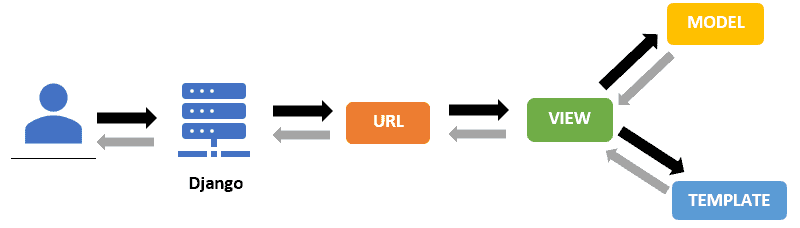
Django is a high-level Python web framework that promotes rapid development and clean, pragmatic design. It follows the Model-View-Template (MVT) architectural pattern, which separates business logic from user interface design, enhancing code maintainability and scalability. Django's built-in ORM simplifies database interactions by mapping database tables to Python objects, allowing developers to perform CRUD operations seamlessly.
| Duration | 2 Weeks | Class Hours | 1 hour/day |
| Lab Hours | 1 hour/day | Prerequisite | Core Python Knowledge |
| Certificate | After successful completion of training | Trainer | Industry Experienced Mentor |
| Study Material | Books, Notes, and Online Tests | Online Test | Unlimited |
| Project | Yes | Lectures In | English / Hinglish / Hindi |
| Fees | Please Call | Placement Support | No |
| Complimentary | Laptop Bag and T-Shirt | ||
About Django
In addition, Django includes an admin interface for managing application data, a robust authentication system, and comprehensive form handling utilities. It supports URL routing, middleware for request and response processing, and a templating engine for dynamic web content generation. Django emphasizes security, with protections against common web vulnerabilities like SQL injection, cross-site scripting (XSS), and cross-site request forgery (CSRF). Its extensive documentation and strong community support make Django an excellent choice for developing powerful, secure, and scalable web applications.
Key Features of Django:
Model-View-Template (MVT) Architecture
Django's architecture separates the application's logic into three components: models for data, views for business logic, and templates for user interface.
ORM (Object-Relational Mapping)
Django provides a powerful ORM for interacting with databases without writing SQL queries directly, improving productivity and security.
Built-in Admin Interface
Django includes an admin interface for managing site content, user authentication, and permissions without writing custom code.
URL Routing
Django's URL dispatcher allows mapping URL patterns to view functions, providing clean and flexible URL structures for web applications.
Template Engine
Django comes with a built-in template engine for generating dynamic HTML content, enabling efficient development of user-friendly web interfaces.
Authentication and Authorization
Django provides robust authentication and authorization mechanisms, including user authentication, session management, and role-based access control (RBAC).
Form Handling
Django simplifies form handling and validation, making it easy to create and process web forms with built-in security features.
Security Features
Django implements security best practices by default, including protection against common web vulnerabilities like SQL injection, cross-site scripting (XSS), and CSRF attacks.
Industrial Applications of Django
Industrial Applications:
Web Application Development
Django is widely used for building dynamic and scalable web applications, including e-commerce sites, content management systems (CMS), and social media platforms.
Enterprise Resource Planning (ERP) Systems
Django's modular architecture and robust features make it suitable for developing ERP systems to manage business processes and resources effectively.
Content Management Systems (CMS)
Django powers popular CMS platforms like Django CMS and Wagtail, providing flexible solutions for managing digital content and workflows.
Financial Services
Django is used in the finance industry for building trading platforms, portfolio management systems, and financial analytics tools due to its security and scalability features.
Healthcare Applications
Django is utilized in healthcare for developing electronic health record (EHR) systems, telemedicine platforms, and medical practice management software.
Educational Platforms
Django powers online learning platforms, course management systems, and educational portals with features for content delivery, assessment, and collaboration.
Government Websites
Django is chosen for government websites and portals due to its security, scalability, and support for compliance requirements.
Complete Django Syllabus
8 Modules · 2 Weeks
The syllabus for Django covers essential concepts and techniques for building web applications using the Django framework. Here’s an overview of the syllabus:
-
- Overview of Django Framework
- Setting up Django Environment
- Understanding MVC and MVT Architectures
- Creating Django Projects and Applications
-
- Defining Models and Relationships
- Working with Django ORM (Object-Relational Mapping)
- Migrating Databases with Django
- Admin Interface and ModelForms
-
- Creating Views and URL Patterns
- Class-Based Views vs. Function-Based Views
- Request and Response Handling
- Template Rendering and Context Data
-
- Creating Templates and Template Inheritance
- Rendering Dynamic Content with Context
- Handling Forms and Form Validation
- Customizing Form Layouts and Widgets
-
- User Authentication and Registration
- Implementing Authentication Middleware
- Role-Based Access Control (RBAC)
- Securing Django Applications
-
- Customizing Admin Interface
- Creating Middleware for Request Processing
- Global Request and Response Handling
- Error Handling and Debugging
-
- Creating Forms and ModelForms
- Handling Form Submissions
- Validating Form Data
- Using Class-Based Views for Form Processing
-
- Introduction to RESTful APIs
- Building APIs with Django REST Framework
- Serialization and Deserialization
- Authentication and Permissions
This syllabus provides a comprehensive overview of Django and equips students with the necessary skills to develop robust web applications using the Django framework.
Why Should a Student or Professional Learn Django?
- Easy to Learn: Django follows the "batteries-included" philosophy, providing everything needed for web development out of the box.
- Versatility: Django can be used to build various types of websites, from simple blogs to complex web applications.
- High Demand: Django developers are sought after in many industries, leading to numerous job opportunities.
- Community Support: Django has a large and active community that offers extensive support, tutorials, and third-party packages.
- Scalability: Django is designed to help developers take applications from concept to completion as quickly as possible, and it scales well for high-traffic sites.
- Security: Django includes built-in protection against many common security threats, helping developers build secure applications.
By learning Django, students and professionals can gain valuable skills in web development, enabling them to create robust and scalable web applications and enhancing their career prospects.
Interesting Facts
Django is a high-level Python web framework that promotes rapid development and clean, pragmatic design. It provides a robust set of tools and features for building powerful web applications. Here are some interesting facts about Django:
1. Created and Development
Origin
Django was created by Adrian Holovaty and Simon Willison in 2003. It was developed to simplify the creation of web applications by providing a high-level framework that encourages rapid development and clean design.
2. "Batteries Included" Philosophy
Comprehensive Features
Django follows a "batteries included" philosophy, meaning it comes with a wide range of built-in features and tools. This includes an ORM (Object-Relational Mapping), authentication, URL routing, and an admin interface, which allows developers to focus on building their applications rather than reinventing the wheel.
3. MTV Architecture
Design Pattern
Django uses the Model-Template-View (MTV) architecture, which is similar to the Model-View-Controller (MVC) pattern. The "Model" handles data, the "Template" manages the presentation layer, and the "View" controls the application logic.
4. Built-in Admin Interface
Admin Dashboard
One of Django’s standout features is its built-in admin interface. This automatically generated admin panel provides a user-friendly interface for managing and editing application data, which can significantly speed up development and administrative tasks.
5. Robust Security
Security Features
Django includes built-in security features to protect against common web vulnerabilities such as SQL injection, cross-site scripting (XSS), and cross-site request forgery (CSRF). This focus on security helps developers build safer web applications.
6. Scalability
Scalable Framework
Django is designed to handle high-traffic websites and scalable applications. It includes features like caching and middleware to optimize performance and scalability, making it suitable for both small projects and large-scale applications.
7. Python-Based
Python Integration
Django is built using Python, which is known for its simplicity and readability. This makes Django a great choice for Python developers, as it leverages Python's strengths to create maintainable and efficient web applications.
8. Strong Community Support
Active Community
Django benefits from a large and active community of developers and contributors. This vibrant community provides extensive documentation, tutorials, and third-party packages, enhancing the framework’s capabilities and ease of use.
9. ORM (Object-Relational Mapping)
Data Handling
Django’s ORM allows developers to interact with databases using Python code rather than SQL. This abstraction layer simplifies database management and provides an easy-to-use API for performing CRUD (Create, Read, Update, Delete) operations.
10. Extensive Documentation
Comprehensive Guides
Django’s documentation is well-regarded for its clarity and thoroughness. It includes detailed guides, tutorials, and references that help developers learn and use the framework effectively.
Training Program Fee
Get Personalized Career Guidance
Our admissions team specializes in helping students choose the right career path for their goals.