
Artificial Intelligence (AI)
Join our AI and machine learning courses to learn artificial intelligence, explore the future of AI, and understand machine learning applications in data science. Start your AI journey today!
Artificial Intelligence (AI)
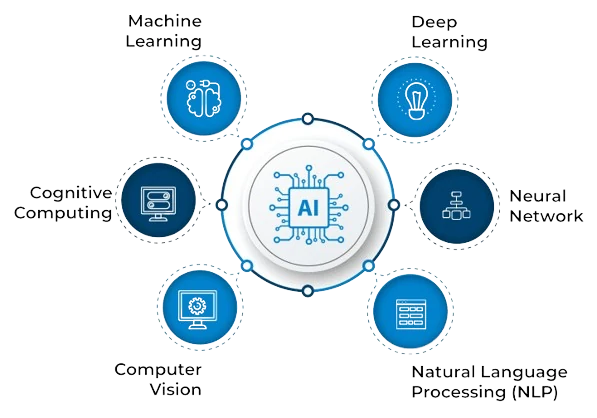
Artificial Intelligence (AI) is revolutionizing various industries by enabling machines to perform tasks that typically require human intelligence. From natural language processing to computer vision, AI technologies are reshaping how businesses operate and interact with customers.
| Duration | 6 Weeks | Class Hours | 1 hour/day |
| Lab Hours | 1 hour/day | Prerequisite | Basic Programming Knowledge (Python recommended) |
| Certificate | After successful completion of training | Trainer | Industry Experienced Mentor |
| Study Material | Books, Notes and Online Tests | Online Test | Unlimited |
| Project | Yes | Lectures In | English / Hinglish / Hindi |
| Fees | Please Call | Placement Support | No |
| Complimentary | Laptop Bag and T-Shirt | ||
About Artificial Intelligence (AI)
Proficiency in AI empowers individuals to develop intelligent systems, automate processes, and derive insights from large datasets. Understanding AI concepts and algorithms is crucial for building innovative applications, optimizing business operations, and driving digital transformation.
Moreover, the field of AI is constantly evolving, with advancements in machine learning, deep learning, and reinforcement learning pushing the boundaries of what's possible. Learning AI opens up exciting career opportunities in fields such as data science, robotics, healthcare, finance, and more.
Following Key Topics to Cover in AI-
7 Modules · 6 Weeks
-
- What is AI?
- History and Evolution of AI
- Types of AI: Narrow vs. General AI
- Applications of AI in Various Industries
-
- Introduction to Machine Learning
- Supervised, Unsupervised, and Reinforcement Learning
- Machine Learning Algorithms: Regression, Classification, Clustering
- Model Evaluation and Validation
-
- Neural Network Basics
- Deep Learning Architectures: CNNs, RNNs, GANs
- Training Deep Learning Models
- Transfer Learning and Fine-Tuning
-
- Text Preprocessing and Tokenization
- Word Embeddings and Word2Vec
- Sequence Models: LSTM, GRU
- Language Generation and Understanding
-
- Image Processing Techniques
- Convolutional Neural Networks (CNNs)
- Object Detection and Recognition
- Image Segmentation and Feature Extraction
-
- Ethical Considerations in AI Development
- Fairness, Accountability, and Transparency in AI
- AI Bias and Mitigation Strategies
- Regulatory Frameworks and Guidelines
-
- AI in Healthcare
- AI in Finance and Banking
- AI in Autonomous Vehicles
- AI in Customer Service and Chatbots
Mastering AI concepts and techniques is essential for unlocking the full potential of artificial intelligence in various domains. This curriculum covers foundational topics required to build intelligent systems, analyze data, and solve complex problems using AI technologies. By acquiring these skills, you can drive innovation, improve decision-making, and create impactful solutions that transform industries and societies.
Why Should a Student or Professional Learn Artificial Intelligence?
- Automation and Efficiency: AI enables automation of repetitive tasks and processes, leading to increased efficiency and productivity in various domains.
- Data-driven Decision Making: AI algorithms analyze large datasets to derive insights and inform decision-making, helping businesses gain a competitive edge.
- Innovation and Disruption: AI powers innovation by enabling the development of intelligent products and services that reshape industries and drive digital transformation.
- Career Opportunities: With the growing demand for AI expertise, learning AI opens up diverse career opportunities in fields such as data science, machine learning engineering, AI research, and more.
Whether you're passionate about technology, interested in solving real-world problems, or seeking to future-proof your career, learning artificial intelligence is a strategic investment that equips you with valuable skills and opportunities in the rapidly evolving digital landscape.
Interesting Facts
Artificial Intelligence (AI) is transforming the IT field by enhancing various aspects of technology and business processes. Here are some interesting facts about AI in the IT field:
1. AI and Big Data
Data Processing
AI can analyze and process massive amounts of data quickly, providing insights that would be impossible to obtain manually. This ability makes AI essential for big data analytics.
2. AI in Cybersecurity
Threat Detection
AI is increasingly used in cybersecurity to detect and respond to threats in real-time. AI systems can identify patterns and anomalies that may indicate security breaches or attacks.
Automated Response
AI-driven tools can automate responses to security incidents, reducing the time to mitigate threats and enhancing overall security posture.
3. AI-Powered IT Operations (AIOps)
Operational Efficiency
AIOps platforms use AI to analyze data from various IT operations tools, providing insights that improve efficiency and reduce downtime through predictive maintenance and automated issue resolution.
4. Enhanced Customer Support
Chatbots
AI-powered chatbots can handle customer queries and provide support 24/7, improving response times and freeing up human agents for more complex tasks.
Sentiment Analysis
AI tools can analyze customer interactions to gauge sentiment, allowing businesses to address customer concerns proactively and improve service quality.
5. AI in Software Development
Code Generation
AI can assist in code generation by providing suggestions, completing code snippets, and even writing code based on natural language descriptions.
Bug Detection
AI-driven tools can analyze code to identify potential bugs and vulnerabilities, enhancing software quality and reducing development time.
6. AI for Predictive Analytics
Future Trends
AI algorithms can analyze historical data to predict future trends, helping businesses make data-driven decisions and anticipate market changes.
7. Automation of Repetitive Tasks
Efficiency Boost
AI can automate repetitive and mundane tasks, such as data entry and processing, allowing IT professionals to focus on more strategic activities.
8. AI in Cloud Computing
Resource Optimization
AI can optimize cloud resource allocation by predicting demand and adjusting resources dynamically, leading to cost savings and improved performance.
9. Natural Language Processing (NLP)
Enhanced Communication
AI-powered NLP technologies enable better understanding and processing of human language, improving interactions with virtual assistants and automating content analysis.
10. AI and Edge Computing
Real-Time Processing
AI is increasingly used in edge computing to process data locally on devices, reducing latency and enabling real-time decision-making for applications like autonomous vehicles and IoT devices.
Training Program Fee
Get Personalized Career Guidance
Our admissions team specializes in helping students choose the right career path for their goals.