
Apache Kafka
Apache Kafka
Apache Kafka is a distributed platform for publishing, subscribing to, storing, and processing streams of records in real-time.Proficiency in Corporate Apache Kafka development is crucial for building real-time streaming data pipelines and event-driven architectures.Skilled Kafka professionals can design and implement scalable, fault-tolerant data pipelines, process streaming data for analytics, and build event-driven microservices.
| Duration | 1 Week | Class Hours | 1 hour/day |
| Lab Hours | 1 hour/day | Prerequisite | Basic Programming Knowledge |
| Certificate | After successful completion of training | Trainer | Industry Experienced Mentor |
| Study Material | Books, Notes and Online Tests | Online Test | Unlimited |
| Project | Yes | Lectures In | English / Hinglish / Hindi |
| Fees | Please Call | Placement Support | No |
| Complimentary | Laptop Bag and T-Shirt | ||
About Apache Kafka
These skills are valuable for roles such as data engineers, system architects, and developers. Mastering Kafka development opens up numerous career opportunities, as its real-time data processing capabilities are increasingly adopted across industries for tasks like monitoring IoT devices, processing user interactions, and analyzing financial transactions.
Following Key Topics to Cover in Corporate Apache Kafka Development-
6 Modules · 1 Week
-
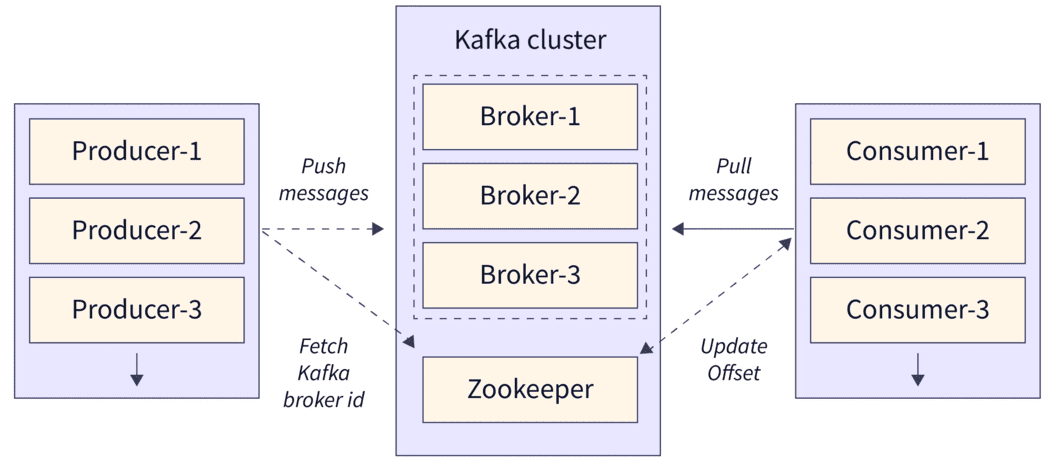
- Overview of Kafka Architecture
- Core Concepts: Topics, Partitions, Producers, Consumers, Brokers
- Installation and Configuration
- Understanding Kafka's Role in Event Streaming
-
- Writing and Configuring Kafka Producers
- Consuming Data with Kafka Consumers
- Handling Message Serialization and Deserialization
- Configuring Kafka Consumer Groups and Partition Assignments
-
- Introduction to Kafka Streams for Stream Processing
- Building Stream Processing Applications with Kafka Streams DSL
- Stateful Stream Processing with Kafka Streams
- Testing and Debugging Kafka Stream Applications
-
- Overview of Kafka Connect for Data Integration
- Using Kafka Connect Connectors for Data Import/Export
- Customizing and Extending Kafka Connect
- Monitoring and Managing Kafka Connect Clusters
-
- Cluster Deployment and Configuration Best Practices
- Monitoring Kafka Clusters with Metrics and Logs
- Scaling Kafka Clusters for Performance and Fault Tolerance
- Backup and Recovery Strategies
-
- Authentication and Authorization in Kafka
- Securing Kafka Clusters with SSL/TLS Encryption
- Using ACLs (Access Control Lists) for Authorization
- Securing Kafka Connect and Kafka Streams Applications
Mastering corporate Apache Kafka development equips individuals to design, implement, and manage real-time streaming data pipelines effectively. This curriculum covers core Kafka concepts, producer and consumer APIs, Kafka Streams for stream processing, Kafka Connect for data integration, administration and operations, and security best practices. By understanding these topics, you can contribute effectively to Kafka projects and enhance your career prospects in the real-time data processing field.
Why Should a Student or Professional Apache Kafka ?
- Real-time Data Processing: Kafka skills are essential for building real-time streaming data pipelines and processing streaming data for analytics and insights.
- Career Opportunities: Proficiency in Kafka development opens up numerous career opportunities in data engineering, system architecture, and software development.
- Scalability and Fault Tolerance: Kafka's distributed architecture provides scalability and fault tolerance for handling large-scale data processing workloads.
- Event-Driven Architectures: Kafka enables the implementation of event-driven microservices architectures for building scalable and resilient applications.
Whether you're a student looking to build a strong foundation in real-time data processing or a professional seeking to enhance your data engineering skills, learning corporate Apache Kafka development is a valuable investment that can lead to significant career growth and opportunities.
Interesting Facts
Apache Kafka is a distributed event streaming platform used for building real-time data pipelines and streaming applications. Known for its scalability and durability, Kafka is widely used in big data and real-time analytics. Here are some interesting facts about Apache Kafka:
1. Origin and Development
Created by LinkedIn
Apache Kafka was originally developed by LinkedIn to handle real-time data feeds and messaging. It became an open-source project under the Apache Software Foundation in 2011.
2. Distributed Architecture
Scalable Design
Kafka is designed with a distributed architecture that allows it to scale horizontally. This means that it can handle high-throughput and large-scale data streams by adding more brokers to the cluster.
3. Publish-Subscribe Model
Flexible Messaging
Kafka uses a publish-subscribe model for messaging. Producers publish messages to topics, and consumers subscribe to topics to receive messages. This decouples data producers from data consumers.
4. High Throughput and Low Latency
Efficient Data Handling
Kafka is known for its high throughput and low latency, capable of handling millions of messages per second with minimal delay. This makes it ideal for real-time data processing and analytics.
5. Durable and Reliable
Data Persistence
Kafka provides strong durability guarantees by persisting messages to disk and replicating them across multiple brokers. This ensures that data is not lost even in the event of broker failures.
6. Stream Processing Capabilities
Kafka Streams
Kafka includes a stream processing library called Kafka Streams, which allows developers to build real-time applications that process and analyze data streams directly within Kafka.
7. Fault Tolerance
Resilient System
Kafka’s architecture is designed for fault tolerance. It replicates data across multiple brokers, ensuring that even if some brokers fail, the system can continue operating without data loss.
8. Integration with Big Data Ecosystems
Versatile Ecosystem
Kafka integrates well with other big data technologies, including Hadoop, Spark, and Flink. This enables seamless data ingestion, processing, and analytics in big data environments.
9. Schema Registry
Data Compatibility
Kafka provides a schema registry that manages and enforces data schemas for messages. This ensures compatibility between producers and consumers and facilitates data evolution over time.
10. Wide Adoption
Popular Choice
Kafka is widely adopted by companies across various industries for its reliability, scalability, and performance. It is used for applications ranging from real-time analytics to event-driven architectures and log aggregation.
Training Program Fee
Get Personalized Career Guidance
Our admissions team specializes in helping students choose the right career path for their goals.